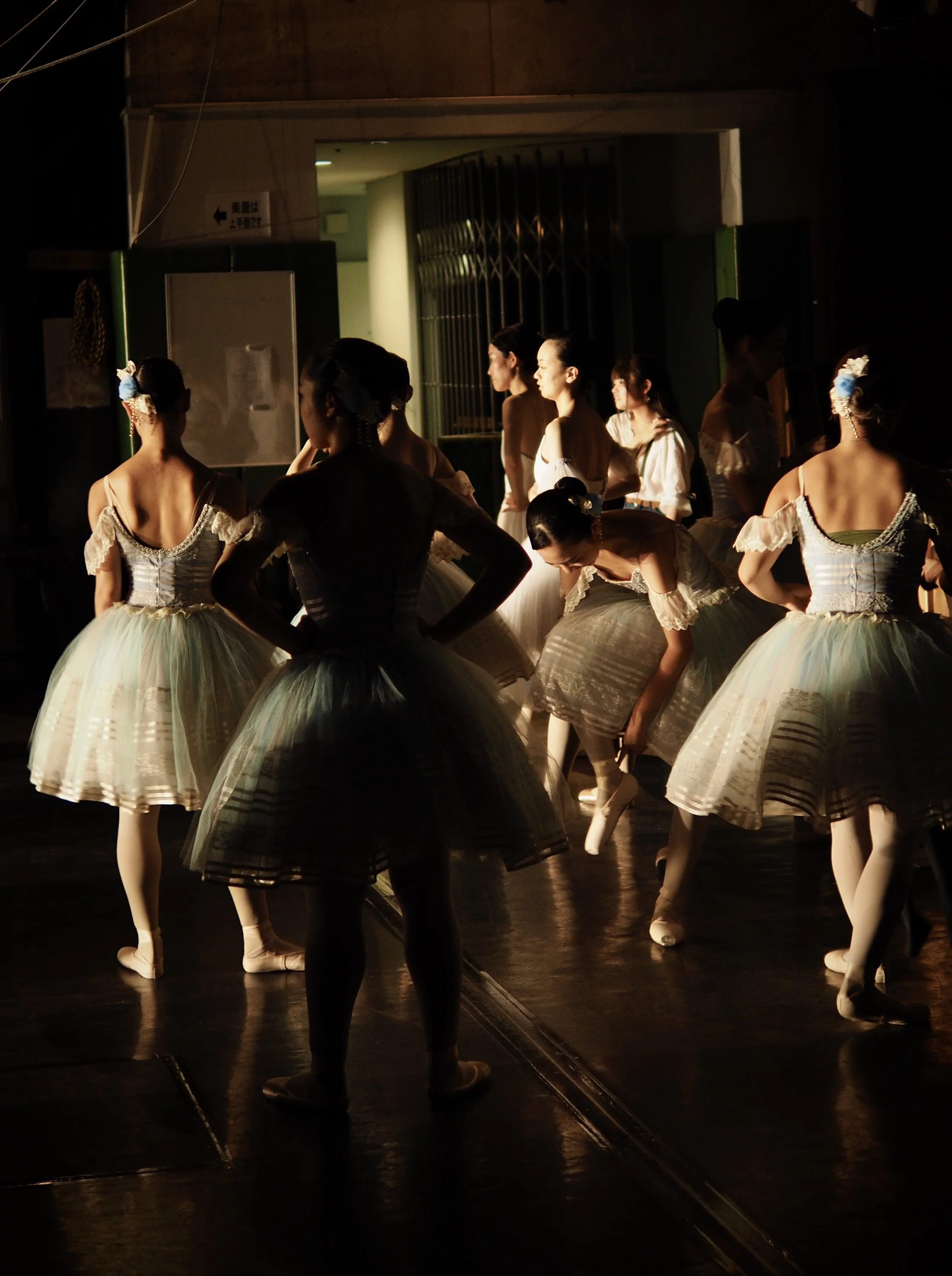
The costume trunk for Seder. As a work which lays bare its compositional structure through explicit verbal explanations, repeated visual cues (like the dancers counting to four on their fingers before breaking into four counts of full-bodied movement), and combined aural and visual information (such as a series of movement accumulations performed to similarly accumulating counts), the dance’s title is appropriate: “seder” is Hebrew for “order.”
This is a bit belated, but here’s a photo journal of my May 5th outing with the Batsheva Ensemble!
It’s been a while since I’ve traveled around and performed for school audiences (I did my fair share of Nutcracker school shows with the American Repertory Ballet in the 1990s, from a tiny soldier to Snow and Flowers corps with a lot in between). But I’ve been able to live vicariously through the Batsheva Ensemble this year thanks to Eldad Mannheim, the company’s manager, who invited me to tag along with the group on a few outings. In January, I joined the Batsheva Ensemble on their trip to Be’ersheva for two morning shows of Ohad Naharin’s Zachacha, and on Monday May 5th, I again accompanied the group as they trekked to Kiryat Shmona for two performances of Naharin’s Seder.
5:55 a.m. Meet the Batsheva Ensemble at the corner of Kaplan and Ibn Gvirol in Tel Aviv. Most of the company members are already snoozing on the bus, and I quickly fall asleep too.
8:30 a.m. Arrive at the theater in Kiryat Shmona in northern Israel. Because of it’s proximity to Lebanon, Kiryat Shmona has been hit by rockets during many clashes with the PLO and Hezbollah, and the town suffered many attacks during the war in the summer of 2006. These performances were sponsored by IDB as a treat for the community’s children, who were no doubt affected by the conflict.
8:35 a.m. Breakfast! There is a long day ahead, so dancers and crew members fill up on fresh bread, veggies, cheese, tehina, coffee, and tea.
9:00 a.m. Hillel Kogan, one of the Batsheva Ensemble’s rehearsal directors, leads a spacing session onstage. Ohad Naharin created Seder for the Ensemble, and the work - which features material from MAX, Shalosh (Three in English), and Furo - debuted in July 2007. The dance can be adapted for anywhere between 12 and 17 dancers; today, 12 Ensemble members are in Kiryat Shmona to perform. Since the dancers know multiple parts and the cast constantly changes, Hillel clarifies who will be dancing each role for these two shows.
9:45 a.m. Gaga onstage, led by Hillel. As with class before Zachacha, this class includes plenty of time for the dancers to stretch and incorporates more familiar technical terminology - plié, relevé, passé, rond de jambe, etc. - than is typically included in the lessons open to the general public. I didn’t dance at all while I was in Tunisia, so I’m happy to get to move and inspired to be surrounded by such amazing dancers!
10:45 a.m. Local schoolchildren and their teachers arrive at the theater. The noise level grows . . .
10:50 a.m. Last minute notes by the dressing rooms. The dancers wear simple gray and black costumes in Seder, but there’s a twist that the audience can’t see: headphones. Part way through the work, one dancer explains (on a pre-recorded audio track) that the performers can move in unison with such precision even when the audience doesn’t hear music because they are listening to counts, beats, music, and other cues via their ear buds. Prior to the performance, the group does a sound check to make sure they are working.
11:00 a.m. (-ish - you know how school shows are . . . ) First performance of the day. Eldad gives a pre-show announcement, and the teachers try to quiet the students as the performance begins.
11:30 a.m. (-ish) The audience gets involved thanks to instructions from a dancer whose head appears on a television screen: put a hand on your heart, put a hand on the back of your neck . . . It’s not a game of Simon Sez constructed especially for young audiences - these children are challenged by the same material that adult audience members would see at an evening performance. How’s that for arts education!
12:00 p.m. (-ish) The first show is over, and the crowd goes wild!
12:20 p.m. Hillel gives notes to the Ensemble backstage while the next group of youngsters fills the auditorium.
12:30 p.m. - 1:30 p.m. Second performance of Seder for a slightly older crowd.
1:40 p.m. The crew starts to strike the set. They’ve had a long day - at 1:00 a.m. they gathered all their equipment from Tel Aviv and made their way to the theater in Kiryat Shmona by 4:00 a.m. to lay down the white marley, put up the set’s panels, and take care of all the lighting and sound work.
1:45 p.m. Lunch and time for some fresh air, sunshine, and beautiful mountain views. From Kiryat Shmona, you can see Lebanon as well as the Golan Heights.
2:00 p.m. Back on the bus to return to Tel Aviv. Many people take well-deserved naps, but I speak with Hillel and a few of the dancers. Two-and-a-half hours is a long trip by Israeli standards, and the traffic as we near Tel Aviv makes the ride a little longer.
4:55 p.m. 11 hours later, I’m home! Almost immediately, I sit down at my computer to upload my photographs and start writing. Another day’s work . . .
Many thanks to Eldad, Hillel, the Batsheva Ensemble dancers, and the crew!
Want to learn more about the Ensemble and read about my trip with them to Be’ersheva? Here’s a link to my blog.
Still want to learn more? The Batsheva Dance Company has a new website that, while still under construction, already has a lot of great information posted. Check it out at http://www.batsheva.co.il/.
Even though this post is LOOONG overdue, I figure it’s better late than never! Here are the final photos that I took at Cedar Lake’s “Glassy Essence” performance a few weeks ago. Thanks again to Caleb and the gang at Cedar Lake for allowing us bloggers to have a sneak peak and for letting the audience take photos! IT WAS HEAVEN!
(The Winger’s very own Kristin Sloan and David Hallberg!)
What did everyone think of the show? Unfortunately, as I was glued behind my lens the whole time, I feel like I didn’t really get to SEE it!
The other day at rehearsal, THE Ana Laguna walked into the ABT studios and watched for about three hours. Ana is Mats Eks wife and ‘muse’ (for lack of a better word). She has danced in many of his ballets and you can see a lot of them on DVD. She also performed at the Fall for Dance Festival last season, dancing a duet with Mats titled ‘Memory’. It brought the house down and was the highlight for me of that festival.
Describing her, a friend of mine put it best… ‘She is that rare artist who is able to focus on her
art at a very high level but yet very aware and sensitive to those around
her. It brings everything to another place….that intensity.’
She is here to dance a pas de deux choreographed by Mats for her and Baryshnikov. It is the Baryshnikov Arts Center’s annual spring gala and I snagged some tickets for the performance. I cannot wait..
Here she is dancing Mats Ek’s Carmen, you will be able to see her around 3 min 45 sec.
The building for Furo, which was constructed especially for the installation at Tel Aviv’s port.
At the entrance to the performance space, this board lists the pairs of dancers who will be performing each loop.
Yam and Inbar, two lovely staff members decked out in uniform who ushered on Friday.
Friday was the opening of Furo, and I made it back to the port for its first few loops (yes, I was hooked - I stayed for 2.5 cycles before tearing myself away). Besides wanting to view the work itself again, I wanted to see how the installation functioned with a real audience. As dance-goers, we’re accustomed to being ushered in together prior to the performance, which has a single fixed beginning. We watch, we clap during the curtain calls, and we get up together to exit at the end. We share an experience within a defined period of time.
With Furo, though, people are issued tickets with a general two-hour time frame. They enter whenever they arrive in that time block, and then they leave whenever they like. Consequently, there’s a nearly constant trickle of people in and out of the installation. It takes quite a coordinated effort on the part of the staff to ensure that this movement does not disrupt the performance, and I observed with interest how several strategically placed ushers reminded audience members to turn off their phones and guided viewers to empty spots in the darkened space. Some fellow viewers stayed for a few cycles, while others chose to leave after they saw all the material (I heard a few whispers of, “We’ve seen this before!”). Although each pair of performers maintains a clear-cut start and finish, each audience member has a different beginning and end. It’s still a shared experience - but it’s much more fluid.
Besides getting my fill of Furo this week, I had the pleasure of seeing the Batsheva Dance Company perform Ohad Naharin’s MAX on Wednesday evening at the Suzanne Dellal Center. The performance was electrifying, and I was overtaken by a powerful compulsion to write when I returned home. This little essay is responsible for a major case of sleep deprivation (I sat down at my computer at 2 a.m. that night!), but I hope you’ll enjoy it:
During the brief blackouts in Ohad Naharin’s MAX, I quickly tore my eyes away from the stage to steal glances at my friend Nitzan. Each time I caught variations of the same expression on his face: eyes wide with amazement and mouth stretched into an even wider grin.
I’ll be the first to admit that I’m a bit of a “dance dork” (a few of my friends in graduate school and I threw around this term frequently). With my penchant for dance history and analysis, I’m probably not the typical audience member. Give me a brilliantly-crafted piece and I will fall in love, counting the ways in which the choreography captures my attention and my affection. Love at first sight is possible in the arena of dance, but sometimes even the most excellent work takes a bit of time to win over my heart fully. Such was the case with Ohad Naharin’s MAX. I first saw MAX in December, and due to fatigue, I didn’t take in the dance with the freshest eyes. When I re-read my files before this second viewing, I saw that I had taken only a few hasty notes which focused on extremely satisfying sections marked by fine compositional structure. But after tonight’s performance of MAX, I’m in love. At least in my eyes, the work as a whole is indeed brilliant.
MAX’s movement is mesmerizing and wide-ranging, from tightly gestural to gloriously full-bodied, from slow and steady to sudden and speedy. At times the dancers work with a meticulous sense of control, while at other points they perform with breathtaking abandon. While inventive and well-executed movement alone can captivate me, MAX also offers plenty of compositional excitement (I told you I was a dance dork!). The pacing of this work was for me, in a word, perfect. Naharin often indulges in one compositional mechanism for longer than many other dancemakers, but the choreographic technique never overstays its welcome – it just blossoms fully. Here’s one example: a dancer tilts wildly out of kilter in a virtuoso solo and then is swept into an explosion of movement from the company, which is scattered across the stage in small groups, each of which has its own phrase; together, the ensemble paints the space with their bodies, arms and legs leaving traces of motion behind them. Out of this grows another solo, which again dissolves into the company’s grouped dancing. After only a few cycles I know what to expect, but my mind still delights in searching for the start of each solo and enjoys the wash of movement from the group. Here and elsewhere, Naharin senses the right moment for a shift and recharges my attention. Sometimes blackouts clear the slate, but more often my eyes are refreshed by extreme juxtapositions: stillness and motion; unison and organized chaos; slow and fast; small and large; smooth and sharp; full ensemble sections and trios or solos.
MAX excited me but in a different way than some of Naharin’s more overtly theatrical productions like Decadance, Zachacha, and Anaphase. Decadance, for one, is absolute fun - I’ve seen it win over several audiences easily. But MAX is in another category. It doesn’t have the theatrical elements which can engage less-seasoned audience members. There is no set, no narrative, and no characters (though for me the gestural motifs, repeated tableaux, and chanting create a sense of a tribe with its own unique rituals). There are no displays of emotion despite one usage of a smile. The dancers are dressed in simple shorts and tanks rather than more elaborate costumes. Furthermore, MAX itself is not an “easy” work. The sound score is challenging. Melodious music played by traditional, recognizable instruments is replaced by low unidentifiable sounds, grating industrial noises, deep eerie male voices speaking in an invented language and droning in counting sections, and long periods of silence. Some people might consider the movement aesthetic challenging as well; there is no attempt at the prettiness of ballet or of some modern techniques despite the inclusion of recognizable classical positions. And in a work that centers so much on composition, the choice of choreographic tools might also prove taxing to certain audience members. The frequent usage of movement accumulations, with repeated movements building into longer and longer phrases, may wear on some viewers’ eyes. So I while I loved the structure and was moved by MAX, I found myself wondering on what level Nitzan (or any non-dance dork) was connecting to the work. Were less seasoned dance viewers enjoying the work’s formal elements? Would they too be moved by the dance?
The answer: yes. The audience clapped enthusiastically for several sets of bows. And as Nitzan’s animated facial expressions suggested, he did indeed enjoy the concert. We talked excitedly about the choreography and the performance of it as we meandered back towards our neighborhood, and without my even asking, he talked poetically about how he connected to the work. MAX was, he said, “Food for the soul.” You can’t get much better than that!
MEGAN KURASHIGE San Francisco Conservatory of Dance San Francisco, California USA BIO | POSTS
Hello!
So, the last time I wrote, I mentioned a performance I was getting ready for, but didn’t actually say much about what we were doing. That was because I didn’t know! When my friend called to see if I’d be interested in a “dance theater” piece that was about sleep and dreams and possibly involved screaming, I thought: well, that seems a bit weird, but it could be fun. There are three of us who are only in the one piece, so it wasn’t until our first performance that we actually grasped what the whole evening is about, whether it would be good or bizarre or awkward.
So… it’s really good. If you’re in SF and have time this weekend or next, head to CELLspace (this weekend) or Yerba Buena (next) and check out Dandelion Dancetheater.
Dandelion is hosting three weeks of physically integrated dance, joined by several artists from Madrid, Montreal, and the (completely awesome) local company, AXIS. The programs are different each weekend, so I’ll only talk about the program I’m in, but I’m sure the Yerba Buena shows will be equally fantastic.
The piece I’m in is called DORS. It’s an excerpt from a longer work by Jacques Poulin-Denis. Here’s a picture of Jacques:
Hm. He looks a bit stern there, but he’s very nice, very funny, and a very, very good dancer. The piece begins with Jacques standing in the dark, holding a small light, and talking about a dream. Quiet disturbances break out and escalate until people are leaping out of the audience, yelling and running through the space, acting out dreams and nightmares. I’m one of three dancers who float across the space like detached sleepwalkers (we improvise with our eyes closed—very exciting when you feel someone race past you at high speed).
Dandelion does this fantastic piece called oust. What blows my mind is how many talents everyone has. People sing and dance and play instruments and speak. It’s like watching some bizarre, slightly cracked, circus that lures you in with a strange spectacle and then suddenly starts talking about all the things that make you uncomfortable.
photo: Hiroki Saito
And a fabulous picture of Eric Kupers, who choreographed the piece (and plays a drum in it…):
photo: Luiza Silva Nadia Adame does this wonderful duet in a chair in oust. She also dances in and choreographed a piece for her own company called 9 dias y 20 horas a la deriva.
photo: Paloma Parra
My favorite piece though, the one I’m really excited to talk about and really, really want everyone to see, is Les Angles Morts. It’s a duet for Jacques and Melanie Demers. I’m not even sure how to describe it, except to say that it made me cry. It says something to you, but without being literal, without pointing out or explaining. It goes from the eye straight through to a place that recognizes it as both familiar and strange. Melanie and Jacques are both so extraordinary, so committed and honest in their movement, that they shook me all over. Melanie does this solo that ends with her walking backwards with a paper bag over her head, gesturing with her arms, and you are hypnotized by every small move that she makes because they are all so carefully considered… Such wonderfulness!
So, if you’re in SF, come see our show. Or keep a lookout for Dandelion, Melanie, Jacques, and Nadia, and if you get the chance, go see them!